Showing posts with label Garden Designers Roundtable. Show all posts

Monday, November 25, 2013

Garden Designers' Roundtable: Journey

To journey through a garden is one of life's great pleasures; the rustle of tall grasses swaying in the breeze and tickling the palms of your hands, the fragrance of flowers calming your mind, and the visual interplay of colors, forms, and textures is always engaging.  The "circulation corridors" throughout your landscape can be designed specifically to slow down your journey and allow you to enjoy all that your landscape has to offer.

The shortest — and quickest — distance between two points is a straight line.  This is great for small spaces or when a high volume of traffic is common.
The short span between the public sidewalk and private residence in Telluride (designer unknown) with  beautiful stone veneer paving.
A wide, smooth surface is safe and efficient for heavy use. The rose pergola in the Royal Botanic Garden at Kew, Great Britain.
One way to slow down your journey is to throw it a curve.  Create a bit of a detour that will encourage your brain to downshift and readjust to a new (garden) experience.
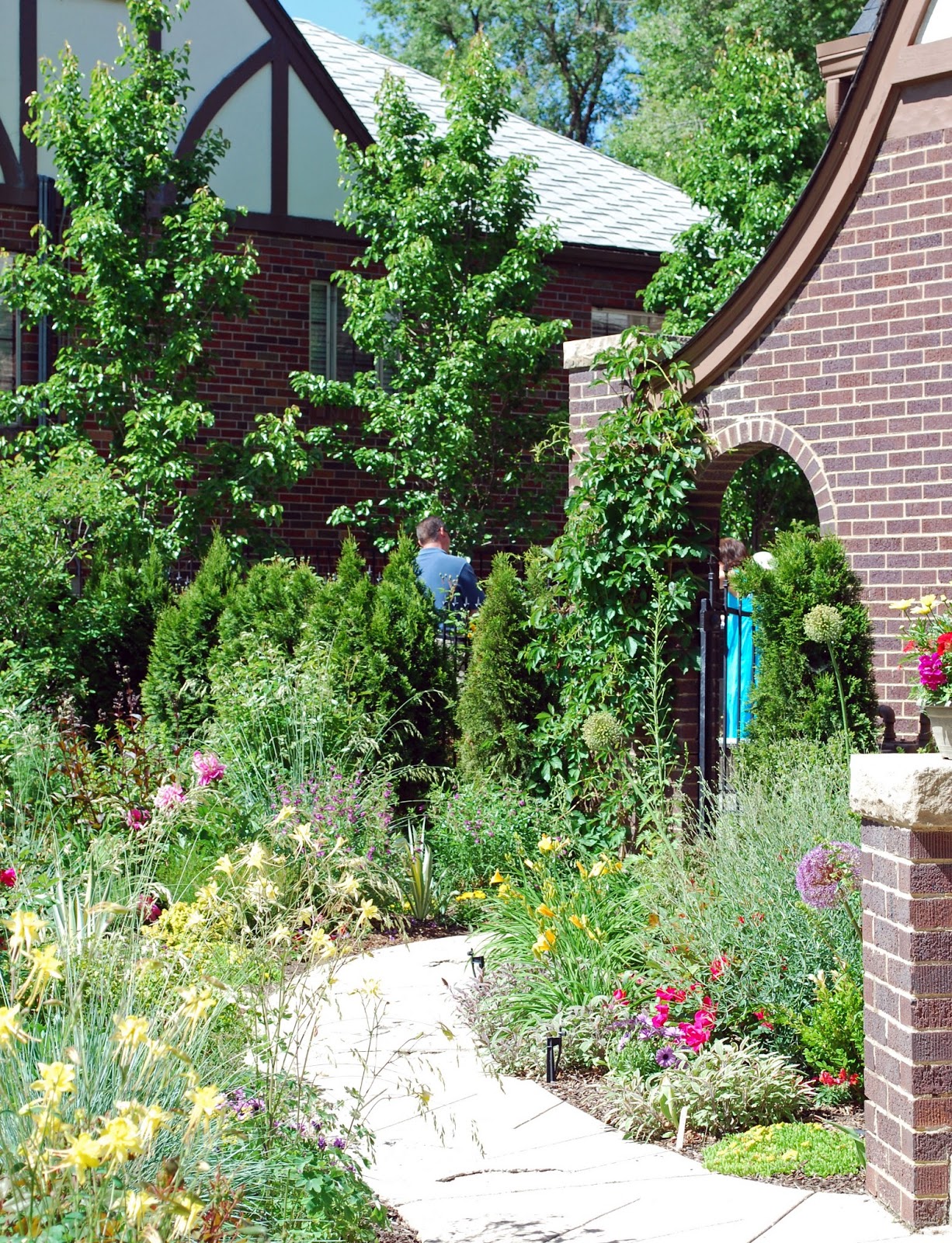
A slower, more enjoyable walk to the front door than the straight alternative, no? (In Denver, CO, designer unknown.)
Bravo to the (unknown) designer for this beautiful, curving stairway in Wheat Ridge, CO — a much more pleasant journey than a straight flight of stairs would offer!
While you're at it, add some height.  This not only reinforces the intent of the curved design (No straying off the path allowed, thank you very much!), but it creates a situation called gradual realization.  When you can't see what's coming around the curve, you tend to slow down a bit while at the same time being pulled forward by the intrigue — humans are awfully curious animals, after all.
My backyard in Wheat Ridge, CO features an active pathway of turf that curves and disappears behind a berm.
This curved, side yard path by Adrienne Brewer in Denver, Colorado, makes for a pleasant journey.
Here's another trick:  make it rough.  Or narrow.  Or crowded.  When your footing is just a little unsteady and each step becomes a conscious act, you will absolutely slow down and enjoy the journey.
This beautifully crafted "river bed path" in the Asian gardens at Denver Botanic Gardens is stunning to look at and creates a noticeable sensation on the feet.
A stone foot bridge in the Japanese garden at the Albuquerque Botanical Gardens in New Mexico, requires a bit of attention if you want to stay dry.  And say, what's beyond that bend?

My side yard garden in Wheat Ridge, CO, is stuffed to the gills.  passage through this garden is definitely slow going.
This rough, curving pathway designed by homeowner Holly Finiau fits all of the criteria for a beautiful garden journey.
Gardening is the epitome of slow living, and life is all about the journey.  Enjoy more posts on this topic by my fellow Roundtable Members here:


All photos by © Jocelyn H. Chilvers.


Monday, October 21, 2013

Garden Designers' Roundtable: Principles of Design

The "principles of design" as applied to the landscape may mean different things to different people (behold the power of the Roundtable!); my take on this topic is informed by my professional training which was based  on a fine arts perspective. The artist's approach incorporates a vocabulary of elements and principles to be used as the building blocks for any type of design — landscape or otherwise.  Mastering these concepts is on-going, but they do provide an excellent rubric for both creativity and analysis/critique.

The elements of design:  line, direction, shape, form, size, texture, value and color. They're the features that are most typically referred to when landscapes and gardens are discussed.  The principles of design are a bit more abstract, and consist of:  repetition, pattern, harmony, gradation (which I wrote about here), contrast, dominance, unity, and balance.

For this discussion, I'll focus on contrast, because I think it's the most powerful and important principle as regards landscape design.  Why?  Most landscapes are comprised primarily of plants (repetition) and are, therefore, very harmonious (lots of similar items).  By placing plant materials with strongly contrasting characteristics next to one another, you bring their differences to the fore and strengthen them as individuals. The plant "characteristics" that I refer to are the elements of design that they present.  Here are a few examples:

This simple planting of yucca and nasturtium is visually arresting because of the strong contrast in foliage texture (size and shape) and plant form (upright and rounded vs. low and horizontal).

The high contrast in flower colors (yellow and purple are opposites on the color wheel) in this photo helps the eye distinguish between similar plant/flower forms.
Design by Denver Botanic Gardens
Contrast in foliage textures and colors are crucial to a garden's success.
Canna and kale design by Denver Parks and Recreation

In a mass planting like this monochromatic perennial garden, contrast in flower value, form, and size, as well as plant form and size, and foliage texture, make for a visual delight rather than a boring mess.
Design by Denver Botanic Gardens
The principle of contrasting elements should be applied to landscapes of any scale and design style, and should be applied to hardscape components as well.  I hope you'll join my fellow members of The Garden Designers' Roundtable for more insights into  the principles of design:


Monday, September 23, 2013

Garden Designers' Roundtable: Enclosure vs. Exposure

Most people crave both public time and private time.  They enjoy being part of a family or a tribe or a community, but they also need time alone to think, refresh, and center themselves. Many landscapes reflect this dual personality as well by featuring areas of exposure and enclosure.

In the urban environment our choices are limited by space, topography, and building codes.  Suburbanites may also have the dreaded HOA restrictions to deal with as well.  Here's a case study (a project that I did NOT design) that shows how small gestures can create the desired atmosphere...

Front yards can be ideal for creating a sense of community, especially when you turn a ho-hum lawn into an intriguing garden. This is especially easy to do when you have a shallow front yard that doesn't lend itself well to extended porches, play areas, or formal courtyards. Passers-by will slow down to investigate and see what's new.  Incorporate a few chairs, and it's easy to strike up a conversation. Embrace the idea of exposure — this is how strong neighborhoods are built.
A comfy chair on the porch and a couple more in the garden are welcoming.
Two chairs are an invitation to stop and visit a while.

In the back yard, privacy can be created softly — no need for massive brick walls or towering evergreens — by layering plant groupings and connecting bits of architecture.  An enclosure that is soft and fluid keeps the spirit of the outdoors alive.  Pop up your umbrella, and the space becomes even more intimate.
Strategically placed plants offer a soft screen

An umbrella or other canopy keeps the space protected and cozy.

A look back towards the street...it's disappeared!

I hope this has given you a few ideas how you can achieve a balance of activity and peacefulness in your landscape.  Join my fellow members of the Garden Designer's Roundtable here for more on enclosure and exposure, or click on the links below.

Monday, August 26, 2013

Garden Designers' Roundtable: Bold

Canna spp.

Has your garden become the only place where you feel safe to express yourself, to vent, to let go of social norms and do a bit of visual screaming?

I hear you.

Use your voice to create something powerful and beautiful — not just noise.  Create bold notes in the landscape to develop focal points that can lead the eye through the space and unify it, too.

Two simple ideas to employ when you want to be bold:  big and bright.

A big object is a bold presence that demands our attention, whether it's the overall plant size (relative to it's surroundings), flowers, foliage, or an in-organic item that's been introduced to the landscape:

Hibiscus spp.
plume grass, Erianthus ravennae
giant silver mullein, Verbascum bombyciferum
an eight foot tall bronze sculpture by Kevin Robb

A bright object catches the eye and is easy to see in a world of green.  Think red, yellow, and white — the colors most easily discerned by the human eye, even in low light:
Bold red tulips in Spring demand that we "Wake up, already!" and leave Winter blah behind.
Acid yellow flowers and foliage is are not to be ignored. Design by DBG.
white glows even on a cloudy day
This brilliant blue hue, unusual in nature, demands our attention. Design by Carol Hines.

Big AND bright?  Powerful stuff:
purple smoke tree, Cotinus coggygria and Achillea at Denver Botanic Gardens
Canna and kale
Hesperalo parviflora. at Kendrick Lakes. Design by Greg Foreman
Cranbe cordifolia

big swaths of bright perennial flowers in the trial gardens at Colorado State University
holiday light extravaganza at Denver Botanic Gardens

Dare to be bold — you may find a voice that you never knew you had.

For more inspiration on the bold landscape, click through the links below:
Garden Designers' Roundtable

Monday, May 27, 2013

Garden Designers' Roundtable: Celebrating Trees

Perennials may be considered the queens of the landscape, but trees are most certainly the kings.  No other plant does more to moderate our climate and set the scale of our outdoor spaces.

Trees are dynamic, colorful, and textural sculptures that control our views, serve as focal points, and unify our neighborhoods and cities.

When I'm selecting a tree for a landscape design I focus on these three key criteria:
Cultural compatibility — will it thrive in the sites' soil, sunlight, and water availability.

A pinyon pine, Pinus edulis, thrives in a narrow planting area adjacent to a sun and heat drenched parking lot.
This protected courtyard planting pocket at the base of a rain chain is the perfect site for a Japanese maple, Acer palmatum in the foothills of Boulder County.
Size — will it fit the space and job it's intended for.
This Colorado blue spruce, Picea pungens, has plenty of room to grow in a suburban  landscape and makes an effective year-round screen.
This ginnala maple, Acer ginnala, is the perfect size for an intensive pruning regime at Denver Botanic Garden's Japanese Garden.
Aesthetics — does it have decorative aspects that are multi-seasonal.
Showy flowers in spring and colorful, persistent fruit via Crimson Cloud hawthorn, Crataegus laevigata 'Superba'
Edible, mid-summer fruit follows springtime flowers, and showy fall foliage color. Autumn Brilliance serviceberry, Amelanchier x grandiflora

Vibrant fall foliage follows a floriferous springtime display on Cleveland Select pear, Pyrus calleryana.
Bark is beautiful, year-round attribute that can't be beat. Shown here:  sycamore, Platanus acerifolia.
Curious about the best trees for Colorado's Front Range? Read about the experts' selections and how those in my own yard rated, here.

Join my fellow Roundtable designers for more, more, and more celebrations of trees!


Monday, April 22, 2013

Garden Designers' Roundtable: Transitions

There are many extremes in the built landscape:
soft and hard,
light and dark,
vertical and horizontal,
big and small.

Sometimes those contrasts are important.  They catch the eye and serve as focal points, or highlight the distinctive attributes of specific plants or hardscape elements within the landscape.

Sometimes, however, that high contrast is just boring, as in this classic "spruce in the lawn" example:

How does one transition from one extreme to another?  How does one create more visual interest,  movement, and shear lushness in the garden? By employing the design principle of gradation. By definition, "gradation is a sequence in which the contrasting extremes are bridged by a series of harmonious steps."*  In the garden, our "harmonious steps" are . . . plants!  We transition from tall to low or big to small with layers of plants.

A large scale application of this idea looks like this:
The gardens at Kendrick Lake feature drought tolerant plants in an undulating, sculptural design by Greg Foreman for the city of Lakewood, Colorado.

At Denver Botanic Gardens, a more formal style of planting transitions the tall, living juniper wall down to human scale.

Here are some examples of smaller, residential gardens that employ gradation:
Vines, columnar trees, and perennials create a lush look in a narrow space walls and walks. Design by Thunderbird Landscaping.

In my home garden, shrubs and perennials create the transition from fence to lawn.

A simpler execution by homeowner Rochelle Elias.

In a narrow space between fence and walk, elevated container gardens substitute for tall shrubs. Design by homeowner Holly Fliniau

This principle can also be applied on a micro level:
Even small planting beds can benefit from a layering gradation of plants. (Designer unknown.)
Containers, too, benefit from transitional plantings. Design by Denver Botanic Gardens.

As you can see, the use of gradation creates transitions that are full, rich, and lively.  How will you apply this design principle in your landscape?

Read more about transitions in the landscape from my fellow members of the Garden Designers Roundtable by clicking the links here:


Thanks for visiting!
*The Art of Color and Design, by Maitland Graves